

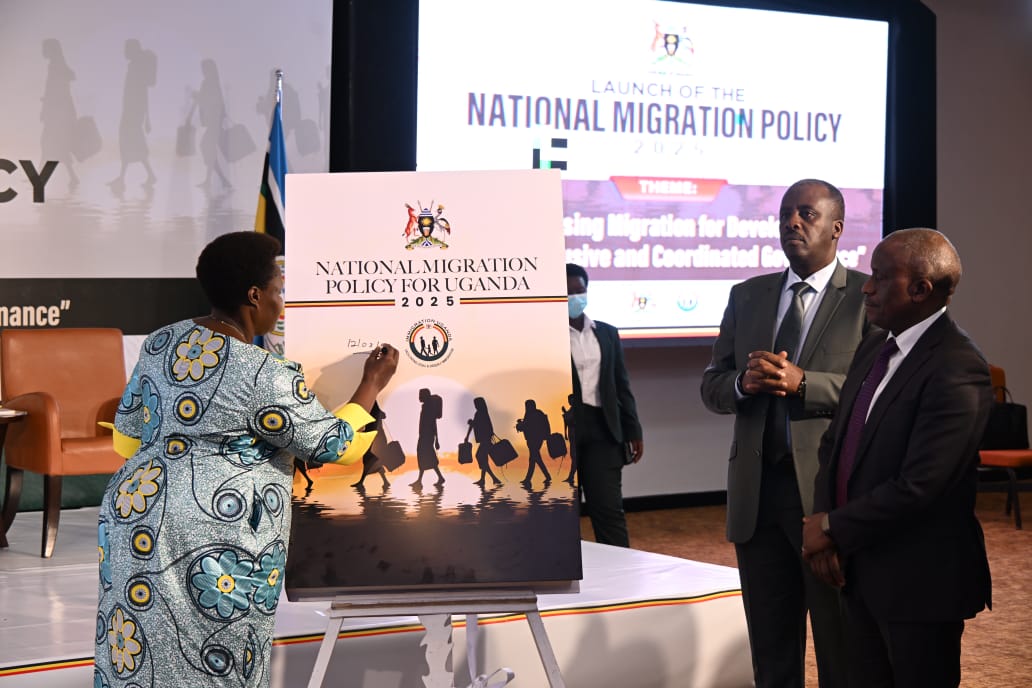
Vice President Jessica Alupo has launched the National Migration Policy 2025, a multi-sectoral framework designed to manage Uganda’s internal, regional, and international migration flows to promote poverty reduction and sustainable growth.
Approved by Cabinet in August 2025, the policy unites relevant Ministries, Departments, and Agencies (MDAs) to ensure coordinated migration governance that supports national development.
Launched under the theme, “Harnessing Migration for Development through Inclusive and Coordinated Governance,” the policy seeks to promote safe, orderly, and regular migration, safeguard migrant rights, enhance border management, address labour migration challenges, and integrate migration into broader development plans.
Speaking at the launch, Alupo said the policy represents more than a government document; it is a declaration of Uganda’s commitment to managing migration in a secure, orderly, and humane manner that benefits both the country and its citizens.
“I commend the Ministry of Internal Affairs for providing leadership in this process and congratulate all stakeholders whose dedication has made this day possible,” she said.
The Vice President emphasized that migration has been central to human societies for centuries, with people moving for safety, education, trade, family reunification, and better opportunities.
She noted that Uganda’s history, geography, and regional position make it deeply connected to these dynamics.
“We are a country of movement, exchange, hospitality, and resilience,” she said, highlighting the nation’s role in hosting refugees, supporting regional integration, and contributing to labour mobility, trade, and human development.
Alupo also called on stakeholders to address the challenges associated with migration, including irregular migration, human trafficking, smuggling, transnational crime, refugee pressures, and the need for stronger coordination and data management systems.
She said the policy is timely, providing Uganda for the first time with a comprehensive framework to guide migration governance, maximize its benefits, and manage associated risks.
The National Migration Policy recognizes that migration is a national issue affecting security, labour, foreign affairs, justice, health, education, trade, and citizen welfare.
“Effective migration governance requires coordination, shared responsibility, and sustained commitment across institutions and sectors,” Alupo said.
She further noted that the policy aligns with Uganda’s national priorities, including the Constitution, Vision 2040, and the National Development Plan, and fulfills regional and international obligations.
Alupo underscored that well-managed migration contributes to development through remittances, investment, labour mobility, trade, tourism, knowledge exchange, and diaspora engagement.
She stressed the importance of recognizing the contributions of Ugandans living abroad, many of whom continue to support families, communities, and businesses at home.
She urged all responsible institutions to take ownership of the policy and translate its provisions into concrete programmes, budgets, regulations, and measurable results.
She called on the Ministry of Internal Affairs to provide continued leadership, while the Inter-Ministerial Technical Committee on Migration should coordinate sector actions, monitor progress, and ensure coherent implementation across government institutions.
State Minister of Internal Affairs Gen. David Muhoozi noted that the policy leverages migration’s positive contributions, such as remittances, skills transfer, and economic opportunities, while mitigating risks including irregular migration, trafficking, and exploitation.
He highlighted Uganda’s progressive refugee policies and underscored the importance of inclusive governance to engage the diaspora and ensure nationwide implementation.
The launch positions Uganda on a path toward responsible, modern, and forward-looking migration governance, affirming that migration is both a development opportunity and a national responsibility.
